Women's health · 8 min read
"It's Like Even My Bones Are Tired."
Why so many women are running on empty after heavy periods, even when their blood work comes back "normal," and why the usual iron pill makes them quit.
It isn't laziness, and it isn't "just your age." Here's the hidden drain most women never hear about, and the gentle way to start refilling it.
By the Oryn Team
You sleep eight hours and wake up tired.
By 3pm you're staring at your screen, rereading the same email for the third time. Walking up one flight of stairs leaves you oddly winded. Your hairbrush has more hair in it than it used to. And somewhere along the way you started telling yourself a story:
"I'm just getting older." "It's stress. It's the kids. It's work." "Maybe I'm just lazy now."
If that sounds familiar, you're not alone, and you're probably not lazy.
Talk to women in their late 30s and 40s, and the same story comes up again and again, almost word for word:
- Periods that got heavier, longer or less predictable.
- An exhaustion that sleep doesn't fix.
- A trip to the doctor, and blood work that came back "normal."
- An iron pill that wrecked their stomach, so they quit.
One woman put it like this:
"It's like even your bones are tired."
This article is about why that happens, why the usual fixes so often fail, and what you can actually do about it.
What you'll learn:
- ✔ The "hidden drain" that can leave you exhausted for months before any red flag shows up
- ✔ Why a "normal" blood test doesn't always mean your iron stores are full
- ✔ The "Quit Cycle" that keeps so many women from ever refilling them
- ✔ The one question to ask your doctor, and the gentle approach that makes it easier to stay consistent long enough to matter
The Exhaustion Nobody Takes Seriously
Here's what makes this kind of tiredness so maddening: you look fine.
You show up to work. You make dinner. You get the kids where they need to be. From the outside nobody sees the effort it takes. As one woman wrote in a review, "you LOOK fine so no one believes you're struggling."
So you push. You white-knuckle it. You plan your week around the days you'll have the least energy, and around the days you'll need dark pants, a spare change of clothes and a seat near the bathroom.
Because for a lot of women, the tiredness comes with a second, quieter fear. One woman described nights as "like sleeping on eggshells. Every move must be strategic or else it's a mess." Another remembered a wedding: "horrifying, cream chairs." And one lawyer wrote about the day she bled through "my menstrual cup, my pad, my period underwear, my pants, and onto the courtroom chair I was sitting in. Right next to my boss, right in front of my judge."
Nobody talks about this at work. Nobody posts it on Instagram. You just quietly plan your whole life around it, and feel exhausted on top.
And when you finally bring it up, you often hear some version of:
"Your labs look normal." "It's probably perimenopause." "Try to get more sleep."
For many women, the hardest part isn't the fatigue itself. It's being made to feel like it's all in their head.
It isn't. And to understand why, you need to know what can happen inside a body that's losing more iron each month than it takes in.
Why Most "Fixes" Don't Fix It
Before we get to the cause, let's look at what most women try first, and why it so often leaves them right back where they started.
Fix #1: Coffee, naps and "pushing through"
The most common solution is no solution at all: more coffee, a nap in the car, an earlier bedtime.
Caffeine can mask tiredness for a few hours, but it doesn't give your body anything it's missing. And here's the catch most people don't know: coffee and tea can reduce how much iron you absorb from a meal when you drink them with it. So the very thing keeping you upright may be making the underlying problem a little harder to fix.
Fix #2: The "normal" blood test
This is the one that keeps women stuck the longest.
A routine blood count mainly looks at hemoglobin, the iron-containing protein that carries oxygen in your red blood cells. If that number is in range, you're often told everything's fine.
But hemoglobin is usually one of the last things to drop. Your body protects it for as long as it can by pulling from your iron stores first. Those stores are measured by a different test called ferritin, which isn't part of a standard blood count and isn't always ordered unless someone asks for it.
That's how so many women end up hearing "normal" while feeling anything but. One woman shared how a specialist explained it to her:
"Low ferritin with normal hemoglobin is like your body writing checks it can't cash."
(This isn't a reason to distrust your doctor. It's a reason to ask a specific question, which we'll come back to.)
Fix #3: The drugstore iron pill
Say you do find out your iron is low. The most common next step is a basic iron pill, very often ferrous sulfate: cheap, everywhere, and for many women, rough on the stomach.
Constipation. Nausea. Cramping. A metallic taste or iron burps. These side effects are common enough that many people simply stop taking it. It's a story women share again and again:
"I have tried SO many iron supplements over the years and they ALL made me constipated and nauseous… take iron for a week, feel awful, quit. Repeat every 6 months when I get desperate again."
We call this the Quit Cycle, and we'll explain below why it's such a big deal.
Fix #4: Treating the symptoms on the outside
When hair starts shedding, the instinct is to treat the hair: biotin gummies, rosemary oil, $60 serums, special shampoos. When skin looks dull, it's a new moisturizer.
Some women say they've spent hundreds of dollars before realizing they might have been working on the outside when the question was on the inside. If low iron stores are part of the picture, no serum can refill them.
Fix #5: Waiting until it's "bad enough"
Some women are told to come back if things get worse. Others are eventually offered iron infusions, which can be very helpful for people who truly need them, but they're expensive, not always covered, and usually not the first step for most women.
So most women do what they always do: they wait, they cope, and they keep going.
Meanwhile, the drain continues.
The Hidden Drain: What Heavy Periods Can Do to Your Iron
Here's what may be going on behind the fatigue, and it's surprisingly simple.
Every period, you lose blood. Every time you lose blood, you lose iron.
For most of your life that's manageable. Your body replaces what you lose from food and keeps a reserve in storage.
But for many women in their late 30s and 40s, periods start to change. During perimenopause cycles can become irregular, and for many women periods get heavier or last longer. Fibroids and other conditions can make bleeding heavier too.
Heavy menstrual bleeding is one of the most common reasons women run low on iron. And when you're losing more iron each month than you're taking in, your body does something clever, and sneaky:
Step 1: It quietly spends your savings. Think of your iron stores (ferritin) as a fuel tank. When monthly losses outpace what you eat, your body draws down the tank to keep everything else running. You may feel a little more tired, but nothing obvious shows up.
Step 2: The tank runs low, and you may start to feel it. As stores dwindle, your body has less iron available for the work it does all day long: carrying oxygen, supporting normal energy production, supporting normal cognitive function. Low iron is commonly linked with signs like these (though each of them can have other causes too):
- Tiredness that sleep doesn't fix
- Brain fog and losing words mid-sentence
- Getting winded on stairs, or a pounding heartbeat
- Cold hands and feet
- Hair shedding and brittle nails
- Craving ice (yes, really) or restless legs at night
Step 3: Only then does the "warning light" come on. Hemoglobin, the number most routine tests focus on, is often the last to fall. It's like a car's fuel light that only comes on when you're almost on empty. You can drive on fumes for a long time before it blinks.
That's the hidden drain. It doesn't announce itself. It creeps up so slowly that, as one woman put it:
"It's amazing how you can get used to such a poor quality of life when it creeps up on you and you don't know any different."
Why Waiting Doesn't Work
If heavy periods are part of your life, the drain doesn't pause while you wait for things to get better on their own. Every heavy cycle is another withdrawal from an already-low account.
That's why so many women describe the same slow slide: a little more tired each season, a little foggier each year, a little less like themselves, until "tired" becomes their personality.
And it's why the Quit Cycle matters so much. Refilling iron stores isn't a one-week project. It generally takes consistent intake over a period of months, not days. If the iron you're taking makes you feel so awful that you quit after a week, you never get anywhere near refilling the tank.
The real problem often isn't that iron "doesn't work" for you. It's that you never got to stay on it long enough for it to have a chance.
An important note before we go further: heavy bleeding itself deserves a doctor's attention, especially if you're soaking through a pad or tampon every hour or two, passing large clots, bleeding longer than usual, or feeling faint or short of breath. A supplement doesn't treat the cause of heavy periods. What it can do is help support your iron intake while you get answers.
"So How Do We Fix It?"
That exact question, in capital letters, sits in the comments under a TikTok video. It's the question behind almost every one of these stories.
The first practical steps are simpler than most women expect:
1. Find out where you stand. Ask your doctor specifically about ferritin (iron stores), not just a basic blood count, and get an actual number.
The question to ask your doctor: "I've been exhausted and my periods are heavy. Can you check my ferritin and iron levels, not just my blood count?" Ask for the number itself, write it down, and ask when it makes sense to re-check.
2. Switch to a gentler form of iron. For many women, the turning point is finding an iron that didn't wreck their stomach. Chelated forms like iron bisglycinate, where iron is bound to an amino acid, are widely chosen by people who couldn't tolerate basic iron salts.
3. Help your body absorb it. Taking iron with vitamin C (a glass of orange juice works) helps your body absorb it, and taking it away from coffee, tea and calcium helps too.
4. Stay consistent for months, not days. When iron doesn't make you miserable, you keep taking it. And consistency is what gives your stores time to rebuild.
That's a simple formula: know your number, choose a gentle iron, help it absorb, and stay with it.
The problem is that most iron on the shelf fails on #2, which means women never make it to #4.
So we went looking for a better option.
Introducing Oryn Gentle Iron: "The Gentle Refill"
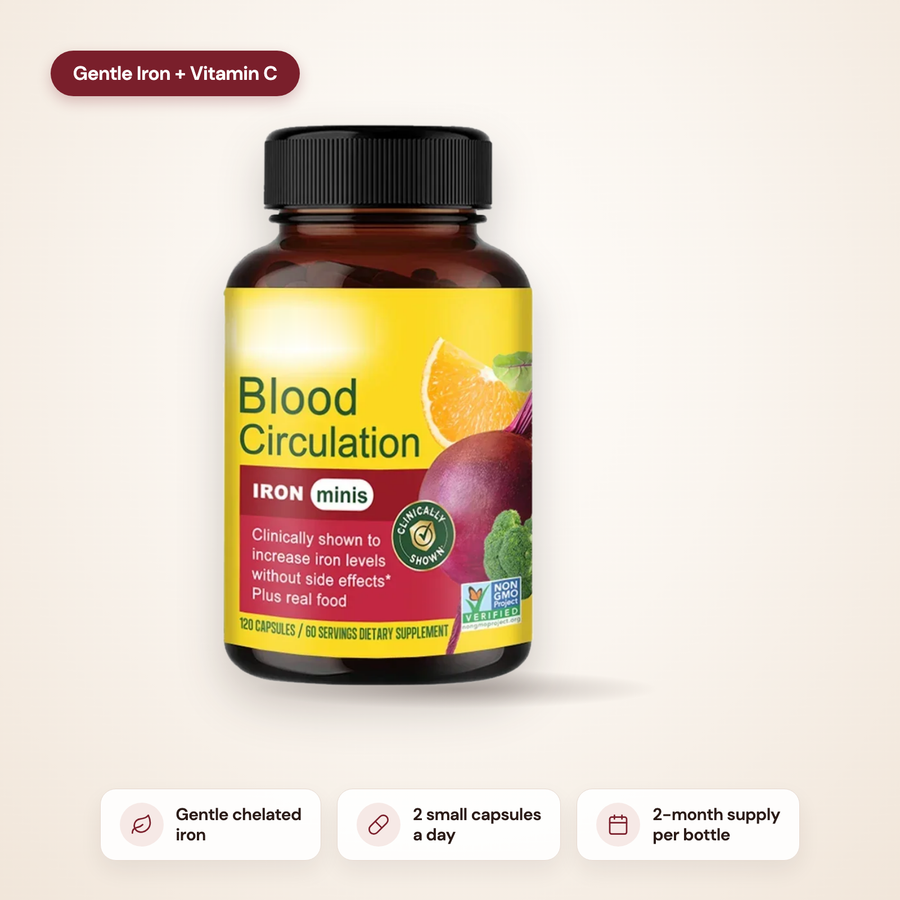
Oryn Gentle Iron was put together around one goal: an iron you can actually stay on long enough to matter.
Instead of a harsh iron salt, each serving pairs gentle chelated iron (iron bisglycinate) with vitamin C, plus folate and vitamin B12, nutrients your body uses alongside iron to make healthy red blood cells, in two small capsules a day.
No megadoses. No mystery blends. No "take six capsules and hope for the best."
3 Ways Oryn Gentle Iron Supports "The Gentle Refill"
1. It's made to be gentle enough to stay on. The whole problem with the Quit Cycle is that harsh iron makes you stop. Oryn uses iron bisglycinate, a chelated form of iron bound to the amino acid glycine, the form many women turn to after basic iron salts didn't agree with them. Everyone's stomach is different, but an iron you can keep taking is an iron that has time to work.
2. It gives your body what it uses alongside iron. Iron doesn't work alone. Your body also relies on folate and vitamin B12 to form healthy red blood cells. Oryn puts them together, so you're not juggling three bottles.
3. It's simple: two small capsules a day. No six-capsule routines. No powders. One bottle lasts two full months, which makes it easy to build the kind of consistent habit that refilling actually takes.
What's Inside Each Serving (And Why It's There)
Serving: 2 capsules. Amounts from the Supplement Facts panel.
Iron (as iron bisglycinate), 26 mg (144% DV) The core of the formula. Iron is essential for making hemoglobin, the protein that carries oxygen around your body, and it supports normal energy metabolism. The form matters as much as the amount. Bisglycinate iron is "chelated," meaning it's bound to an amino acid. That's why it's commonly chosen by people who couldn't tolerate basic iron pills. 26 mg is a meaningful daily amount without being a megadose.
Vitamin C (as ascorbic acid), 15 mg Vitamin C helps your body absorb iron. We'll be straight with you: 15 mg is a small, supporting amount. For an extra boost, take your capsules with a glass of orange juice or a vitamin C-rich meal.
Folate, 680 mcg DFE (170% DV) Folate plays a key role in normal red blood cell formation and normal cell division.
Vitamin B12, 30 mcg B12 also supports normal red blood cell formation, normal energy metabolism and a healthy nervous system. It's a common gap for women who eat little red meat.
Organic beetroot and a whole-food blend (organic brown rice, orange, broccoli) A small whole-food base. We include it because it's in the formula, not because it's a meaningful source of iron. We'd rather be honest about that.
What's NOT inside: no megadose vitamin B6, no stimulating herbs, no artificial colors.
What to Expect, Week by Week
Refilling iron stores is a process, not a switch. Here's the honest picture. Everyone is different, so individual results vary.
Weeks 1–2: Build the habit. Take two capsules a day, ideally at the same time. If your stomach is sensitive, take them with food. Keep coffee, tea, dairy and calcium supplements a couple of hours apart from your capsules.
Weeks 3–6: Watch for small changes. Some women notice small things first: getting through the afternoon a little more easily, or not needing that second coffee. Others take longer, and that's normal.
Weeks 8–12: Check your number. This is a good time to ask your doctor about re-checking your ferritin, so you can see actual progress instead of guessing, and decide together how long to continue.
Months 3–6: Keep refilling, if your doctor agrees. Iron stores generally take months, not days, to rebuild, especially if heavy periods keep drawing them down. That's exactly why a gentle formula you can actually stay on matters.
And the part that has nothing to do with lab numbers: the afternoon you don't need to lie down. The meeting where the words come when you need them. The day you stop planning everything around how tired you'll be. That's what so many women say they want back, more than any number.
How Oryn Compares
| Oryn Gentle Iron | Basic drugstore iron | Typical gentle iron (iron only) | Beef liver capsules | |
|---|---|---|---|---|
| Form of iron | Iron bisglycinate (chelated) | Usually ferrous sulfate | Usually iron bisglycinate | Natural food iron; amount varies |
| Iron per serving clearly stated | ✔ 26 mg | ✔ | ✔ | Often not stated |
| Folate + B12 included | ✔ | Usually not | Often not | Some naturally |
| Capsules per day | 2 small | 1 | 1 | Often up to 6 |
| Written for women with heavy periods, with a ferritin guide | ✔ | No | No | No |
| 90-day money-back guarantee | ✔ | No | Varies | Varies |
Honest note: if a simple gentle iron already works for you and your doctor, stick with it. Oryn is for women who want iron, folate and B12 in one easy routine, with clear guidance on testing and a guarantee behind it.
A Note From the Oryn Team
We started Oryn because so many women have given up on feeling good: not because nothing could help, but because everything they'd tried either didn't work or made them feel worse.
So here's what we'd ask of you.
First, know your number. If you haven't already, ask your doctor to check your ferritin. And if your periods are very heavy, please get that looked at too. You deserve answers.
Second, give your body enough time. Refilling iron stores isn't a one-bottle project, especially when heavy periods keep drawing them down. That's why we recommend three bottles: six months of supply, enough to get you past your first re-check with your doctor.
Whichever option you choose, you're covered by our 90-day money-back guarantee. If Oryn isn't right for you, contact us within 90 days for a full refund.
Here's to feeling like yourself again.
The Oryn Team
Where Are You Right Now?
Already know your ferritin is low? You've done the hardest part. Choose your supply below and start your gentle refill today.
Haven't been tested yet? Ask your doctor the question above. Many women order now so they can start as soon as they've talked it through, and the 90-day guarantee gives you time to do exactly that.
Choose Your Supply
| Starter | Recommended | Full Year | |
|---|---|---|---|
| Bottles | 1 bottle | Buy 2, Get 1 Free (3 bottles) | Buy 4, Get 2 Free (6 bottles) |
| Supply | 2 months | 6 months | 12 months |
| Price | $34.99 | $69.99 | $127.98 |
| Subscribe & save 15% | $29.74 every 2 months | $59.49 every 6 months | $108.78 every 12 months |
| Cost per day (one-time) | ~$0.58 | ~$0.39 | ~$0.36 |
| ✔ Covers your first doctor re-check | ✔ Lowest price per day, for women whose doctor has advised longer-term iron |
✔ 90-Day Money-Back Guarantee · ✔ Free shipping on bundles · ✔ Optional subscription: skip, pause or cancel anytime from your account
Frequently Asked Questions
Will Oryn upset my stomach? Oryn is built around iron bisglycinate, the gentle, chelated form women most often switch to after drugstore iron didn't agree with them. It's just two small capsules, and you can take them with food if your stomach is sensitive. And if it's not right for you, you're covered by our 90-day money-back guarantee.
How long until I notice a difference? Some women notice small changes, like an easier afternoon, within a few weeks. Rebuilding iron stores takes a few months of steady use, which is why we recommend the 3-bottle option: six months of supply, enough to take you past your first ferritin re-check. Individual results vary.
My blood work was "normal," or I haven't been tested yet. Is Oryn for me? A routine blood count often doesn't include ferritin, so "normal" doesn't always mean your iron stores are full. Many women order Oryn and ask for a ferritin test at their next appointment, so they have everything ready. The 90-day guarantee gives you plenty of time to do both.
I've seen cheaper gentle iron. Why choose Oryn? Most cheaper options give you iron alone. Oryn pairs gentle iron bisglycinate with folate, B12 and vitamin C in one simple two-capsule routine, comes with clear guidance on testing, and is backed by a 90-day money-back guarantee. With the 3-bottle option, it works out to about 39 cents a day, less than a coffee.
I already tried iron bisglycinate. Will this be different? Often iron "doesn't work" because it wasn't taken long enough, or it was taken with coffee, tea or calcium, which block absorption. Oryn adds folate, B12 and vitamin C, and comes with a simple routine built for consistency. Give it the months it needs, knowing the 90-day guarantee has you covered.
What about beef liver or lactoferrin? Both get a lot of attention online. Beef liver's iron content varies, often means several capsules a day, and comes with a lot of vitamin A. Research on lactoferrin is still early. Oryn gives you a measured 26 mg of gentle iron in two small capsules, so you always know exactly what you're getting.
Will Oryn help with my heavy periods? Oryn doesn't treat heavy bleeding itself. What it does is help you keep up with the iron that heavy periods take each month. If your bleeding is very heavy or has changed, it's worth having it checked by your doctor too.
Can I take it with my other medications or supplements? Iron works best taken a couple of hours apart from thyroid medication, certain antibiotics, antacids, calcium, coffee and tea. If you take a prescription medication, a quick check with your pharmacist is all you need.
How many capsules are in a bottle? 120 capsules. At 2 a day, one bottle lasts a full 2 months.
How does shipping work? Every order ships with tracking, sent to your email as soon as it leaves us. Delivery usually takes 7–12 business days after your order ships. Shipping is free on orders of $65 or more, including our 3- and 6-bottle bundles. See our shipping policy.
What if it doesn't work for me? You're covered by our 90-day money-back guarantee. If you're not happy for any reason, contact us within 90 days for a full refund. You have nothing to lose by trying it.
Our 90-Day Money-Back Guarantee
Try Oryn Gentle Iron for up to 90 days. If you're not happy for any reason, contact our team and we'll refund your purchase. Read our refund policy.